

The cybersecurity market recently reacted the way it always reacts to something it doesn’t fully understand: with sudden turbulence.
When Anthropic launched Claude Code Security, a feature built directly into its agentic coding assistant to scan codebases using contextual reasoning rather than static rules, traditional security stocks tumbled. Static Application Security Testing (SAST) providers felt the shockwave, and the market braced for an AI-driven overhaul of software development.
To be completely fair: Claude Code Security is a phenomenal piece of technology. It represents a massive leap forward for Shift Left, the practice of moving security checks earlier into the development lifecycle to catch bugs before they ever reach production.
But as software engineering teams rush to embrace “vibe coding” and agentic AI development, a massive structural blind spot is opening up. The technology solves a code execution problem. It does not solve, and in fact, actively accelerates, a chaotic identity and Shadow SaaS problem.
1. Vibe Coding at 10x Speed: The Shadow SaaS Explosion
The promise of agentic AI is pure velocity. Engineers using Claude Code can spin up microservices, draft applications, and ship features at a pace that was unimaginable a few years ago.
But speed is the natural enemy of IT procurement and identity governance.
When a developer uses an AI agent to build a new tool, they don’t stop their momentum to open an IT ticket and wait weeks for a staging database, a niche deployment platform, or a testing utility to be approved and provisioned. They do what any fast-moving engineer does: they sign up for a new tool right from their browser using a password or a personal credential.
This creates a paradox:
While Claude Code is busy ensuring that the internal application code is pristine and structurally sound, the human developer is actively spawning a chaotic, untracked ecosystem of Shadow SaaS to host, test, and run that code.
2. The Identity Arsenal Gap: Where Traditional IdPs Fail
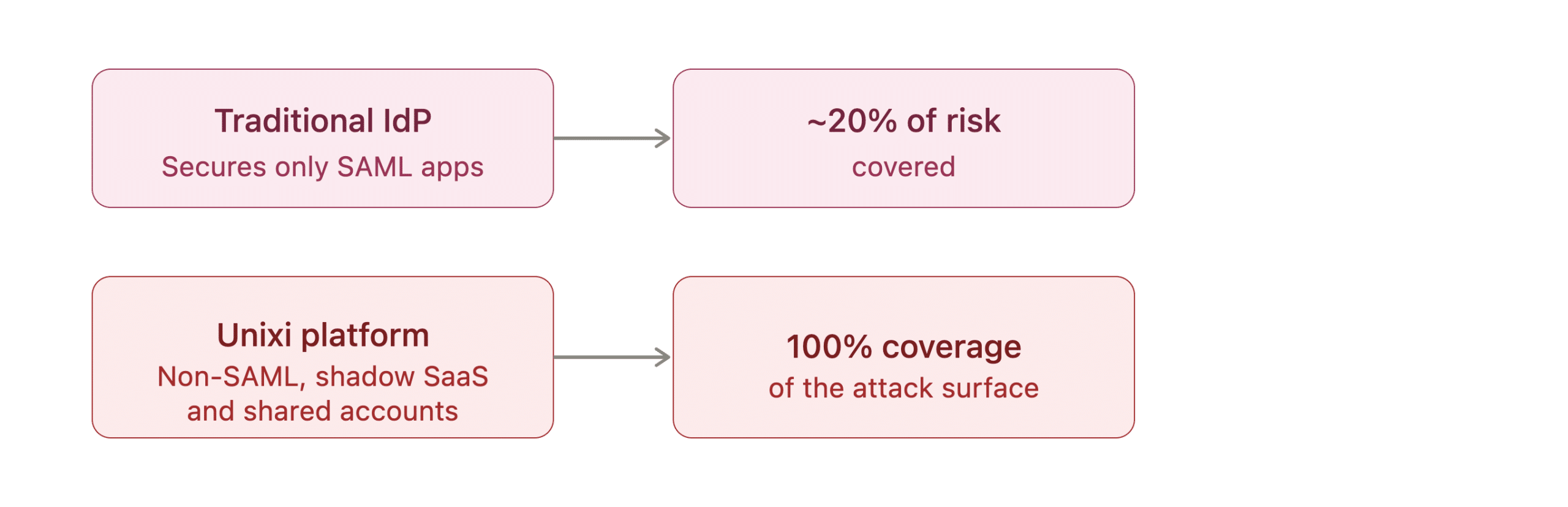
Traditional Identity Providers (IdPs) like Okta or Azure AD (Entra) are designed around strict corporate perimeters and enterprise-grade protocols like SAML and OIDC.
The problem is that the vast majority of niche developer tools, staging environments, and cutting-edge AI infrastructure platforms don’t support SAML – or they hide it behind an expensive vendor “SSO Tax“.
These are uncontrolled applications. Because they operate completely outside of the corporate identity perimeter, developers default to using weak, shared, or reused passwords to collaborate and link their systems together.
This is the Identity Arsenal Gap. Your code scanner can verify that your software has no SQL injection vulnerabilities. However, it cannot see that the master login to the infrastructure hosting that code is a shared password saved in a developer’s browser. Attackers understand this gap perfectly. They don’t need to break sophisticated AI code; they just target the uncontrolled, non-SAML applications surrounding it via phishing or credential stuffing.
3. The Offboarding Nightmare and “Residual Accounts”
The danger of this uncontrolled AI pipeline becomes critically clear during employee offboarding.
Imagine a senior engineer who leverages Claude Code to automate a complex deployment pipeline, integrating five different uncontrolled developer tools along the way. Months later, that engineer leaves the company.
HR and IT trigger the standard offboarding workflow: the employee’s primary identity is deactivated in Okta. On paper, their access is severed.
In reality, the residual accounts, the shared logins, the non-SAML testing environments, and the browser-cached developer accounts used to configure that AI pipeline – remain completely live and active. Because the enterprise has zero visibility into these shadow tools, these orphan accounts sit exposed in the wild, creating a massive, unmonitored backdoor into the corporate network.
4. The Unixi Approach: Extending SSO to All Your Apps
We cannot stop the adoption of agentic tools like Claude Code, nor should we. Organizations that build with AI will out-pace and out-innovate those that don’t. The solution isn’t to restrict the technology; it’s to ensure your identity perimeter evolves to govern the chaos it leaves behind.
This is exactly why we built Unixi.
Unixi bridges the Identity Arsenal Gap by extending central access control to every single browser-based application, whether it supports SAML or not, with absolutely zero vendor integrations or configuration headaches required.
- Continuous Shadow SaaS Discovery: Unixi automatically uncovers the hidden developer tools, shared accounts, and niche SaaS platforms your engineers are spinning up to support their AI workflows.
- Universal SSO & Password Elimination: By replacing manual password inputs with secure, one-button login driven by Key Derived Authentication (KDA), Unixi completely removes user-managed passwords from the equation. If there is no password to type, there is no password to be phished, leaked, or hardcoded into an AI prompt.
- Total Login Restriction: Unixi allows security teams to define their approved ecosystem. If a developer tries to spin up an unvetted third-party tool to drop code into, Unixi can automatically halt the unauthorized access, ensuring governance is enforced in real-time.
- Bulletproof Lifecycle Management: When an engineer leaves, Unixi doesn’t just cut off the primary directory access. It seamlessly cuts off access to all the uncontrolled, non-SAML, and residual developer accounts they touched, leaving zero operational blind spots.
Elevate Your Posture
Shift Left is an excellent philosophy for protecting your codebase. But code is only as secure as the identity perimeters guarding the systems around it. Use AI to write better software faster, but use Unixi to ensure your environment stays entirely under your control.