

In Part 1, we looked at the Vercel 2026 breach as a case study in Shadow AI becoming an enterprise identity attack path.
The breach did not start with a zero-day, direct phishing of Vercel, or a stolen Vercel password. It started earlier, at the moment an employee self-adopted a consumer-grade AI tool and granted it broad Google Workspace permissions. That OAuth grant turned Context.ai from a simple productivity tool into a trusted bridge between a third-party AI application and Vercel’s corporate identity environment, and once Context.ai was compromised, that bridge became the attacker’s path downstream.
This is the core Shadow AI problem: security teams often try to detect the breach after the identity relationship has already been created. But by then, the most important control point has already been missed. The better place to stop the chain is at the point of adoption, before an employee can delegate corporate identity and data access to an unreviewed AI tool, and this is where Unixi and its AI governance changes the model.
Unixi’s value in a Vercel-like scenario is that it gives security teams visibility and control over the Shadow AI relationship before it becomes trusted. If an employee tries to use a consumer AI application with corporate credentials, Unixi can discover the app, classify it, place it into a risk workflow, restrict it, block it, or require security approval before the identity bridge is created.
The Real Failure: Not Just Token Theft, But Ungoverned Trust
Describing the Vercel Breach as a token theft incident is technically true, but incomplete. Those tokens only mattered because a corporate user had already authorized a third-party AI tool to access their Google Workspace environment. Let’s look again at the attack timeline.
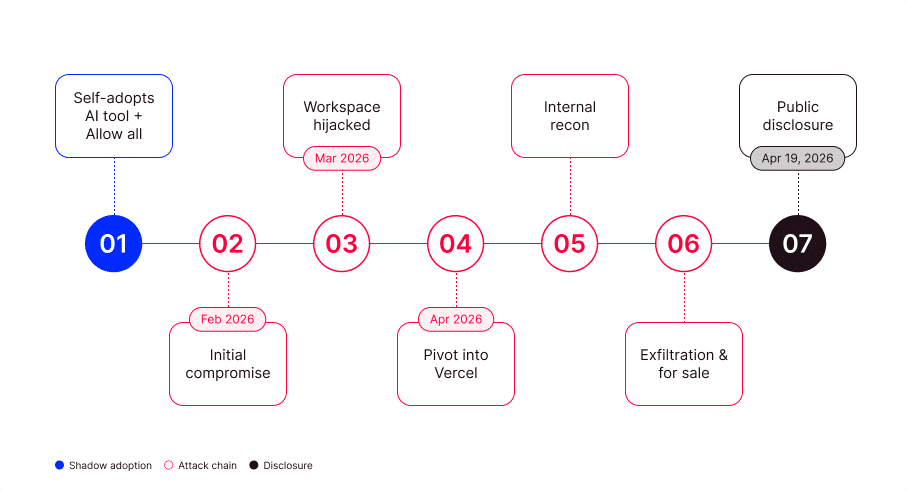
The AI tool was not reviewed, contracted, governed, or placed into an approved application ecosystem. It did not go through the same process that an enterprise SaaS vendor would normally go through. A single employee was able to create a high-risk identity relationship by clicking through a consent screen. This is why the incident should not be understood only as a third-party compromise. It was also a governance failure, and this is exactly the gap Unixi is designed to close.
How Unixi Discovers Shadow AI
Unixi discovers Shadow AI from the browser, where the adoption actually happens. Its secure browser extension observes application usage at the point of login, instead of relying only on network logs, procurement records, or delayed API scans.
When a user signs in to an application with corporate credentials, Unixi detects the activity in real time, maps the domain to a known application, and checks whether that app belongs to the organization’s approved ecosystem. If the app is unknown, unapproved, or outside policy, it is classified as shadow usage. This browser-level visibility is important because it captures the tools traditional discovery often misses: unmanaged SaaS apps, non-SAML applications, consumer AI tools, and AI platforms employees start using on their own.
From Discovery to Control: Unixi for AI
Discovery alone does not solve Shadow AI. It only tells security teams where the risk exists. The next step is risk analysis: determining whether an AI tool is approved, who is using it, what identity they used, what data it may access, and whether it creates a trusted path into corporate systems.
Unixi’s AI Access Governance closes that loop. Once an AI application is discovered, Unixi can evaluate it against the organization’s approved application ecosystem and apply policy. An app that is approved can remain available under governance. An app that is unknown, consumer-grade, risky, or outside policy can be restricted, routed for approval, or blocked before a user delegates corporate identity to it.
For AI, this control model extends beyond simple login decisions. Chatbot and AI-application usage can be restricted, MCP and integration access can be revoked, and the MCP handshake itself can be governed. This turns Shadow AI from an invisible adoption problem into a managed lifecycle: discover the tool, analyze the risk, enforce policy, and revoke access when the relationship is no longer approved.
How Unixi Would Have Stopped the Vercel Breach
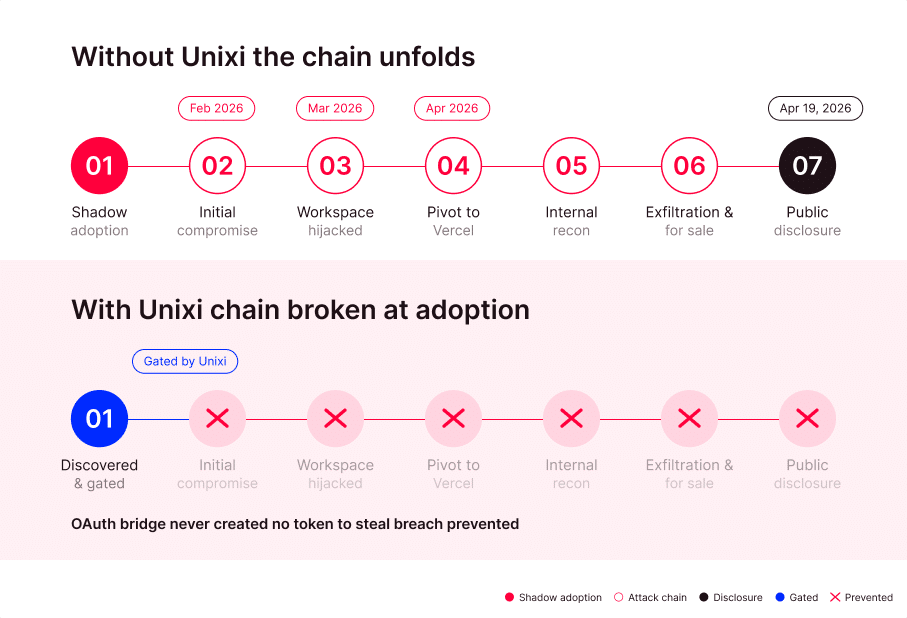
The decisive point of the Vercel breach is the very first step – the self-adoption of Context AI Office Suite. Everything downstream depended on the OAuth bridge that step created.
When the Vercel employee opened Context.ai in the browser and attempted to sign in with their corporate Google Workspace account, Unixi’s extension would have detected the login at the point of interaction and mapped it to the Context.ai application. Because the app was not contracted, not approved, and not part of Vercel’s approved ecosystem, it would have been classified as Shadow AI immediately. The risk signal would have been even stronger because this was a consumer-grade AI office suite requesting broad Google Workspace OAuth scopes.
With Login Restriction enforcing the approved application ecosystem, Unixi could have blocked the connection outright or routed it to security for approval before the employee reached the “Allow All” consent step. That is the decisive difference.
- If the OAuth grant is never created, Context.ai never holds a Vercel-related Google Workspace token.
- If that token does not exist, an attacker who later compromises Context.ai has no Vercel OAuth bridge to abuse.
| Breach step | Unixi capability | Result |
| Employee signs into Context AI with corporate account | Browser-based discovery at point of interaction | Login observed in real time; app mapped to Context.ai |
| App is unknown / not in approved ecosystem | Risk analysis + approved-app ecosystem | Flagged as shadow AI; broad-scope consumer AI tool rated high risk |
| Employee clicks “Allow all” on OAuth consent | Access management / Login Restriction | Connection blocked or routed for approval; OAuth grant never created |
How Unixi Breaks the MITRE Chain
The MITRE ATT&CK mapping in Part 1 shows how the attacker progressed through a chain of techniques. Unixi breaks that chain at the start by preventing unauthorized OAuth adoption and enforcing approved application access, stopping later stages from occurring.
| Attack Stage | MITRE Technique | Unixi Disruption |
| Self-adopted AI tool | T1199 — Trusted Relationship | Detects unapproved AI app before trust is created |
| OAuth token creation | T1528 / T1550.001 | Blocks or gates access before token exists |
| Cloud account abuse | T1078.004 — Valid Accounts: Cloud Accounts | Prevents the third-party bridge into corporate identity |
| Cloud discovery | T1580 — Cloud Infrastructure Discovery | Stops attacker before internal discovery stage |
| Secrets exposure | T1552.001 — Credentials in Files | Prevents downstream access to environment data |
| Exfiltration/extortion | T1567 / T1657 | Disrupts the chain before data access |
Conclusion
Part 1 showed that the self-adopted AI tool became the trusted bridge into Vercel. Part 2’s argument is the mirror image: if that bridge is discovered and governed at the moment it is created, the entire downstream chain collapses. Unixi’s lifecycle model is designed to intervene at that exact point by combining browser-based discovery, real-time risk analysis, and enforcement of an approved application ecosystem.
The lesson of the Vercel breach is not that AI tools are dangerous. It is that ungoverned identity bridges are dangerous, and that the most effective control is the earliest one. Discover shadow AI as it is adopted, decide on it before a corporate identity is delegated, and govern it across its lifecycle, so the next Context.ai never becomes the next bridge.