
For decades, passwords have been the backbone of digital identity. They remain the keys to every browser-based application, yet the security community knows a stubborn truth: passwords are still the #1 attack vector for data breaches.
A recent CSO Online article, “Enterprise passwords becoming even easier to steal and abuse” (Aug 2025), underscores the obvious: human beings should never be expected to carry the burden of identity security when technology offers better solutions.
So, why are organizations still relying on users to “do the right thing” with passwords?
The Core Problem: Human Nature
Security professionals preach “best practices” like long, random passwords, no reuse across sites, and frequent updates. But let’s be honest, employees under pressure to stay productive don’t want the hassle.
The result? They reuse passwords, pick weak variations, write them down, store them in hackable vaults, and fall for phishing attacks. In other words, passwords aren’t just weak, they’re actively undermined by human behavior.
“It Can’t Happen to Me” Thinking
If you think insecure passwords are rare, think again.
- In the McDonald’s 2025 breach, the admin password was literally 123456, exposing millions of applicant records. Can you say with confidence that you don’t have users using the exact same password?
- In the Okta 2023 breach, an employee stored service account credentials in Google’s password manager creating a goldmine for hackers once breached.
- At Unixi, our weekly enterprise discoveries reveal weak or default passwords in 100% of organizations we assess.
This isn’t an anomaly, it’s systemic.
Attackers Have the Upper Hand
Hackers don’t need to work hard when passwords are in play:
- Modern cracking tools guess billions of combinations per second.
- Phishing kits are turnkey, requiring little technical skill.
- AI-powered bots like Anthropic’s Claude have already been leveraged to craft successful ransomware attacks.
- Info-stealing malware can quietly siphon credentials for months.
- Social engineering remains so effective that attackers often extract passwords over the phone in minutes.
Even when “secured,” credentials are stored using outdated algorithms or misconfigured systems, making them trivial to crack. Passwords aren’t security. They’re bait.
Why Are We Still Blaming Users?
Every major breach headline blames weak credentials or compromised accounts. The implication? That the user should have picked a stronger password or avoided clicking the wrong link.
But this is backwards. Why are we pushing the responsibility for identity security onto end-users when we know the system itself is flawed?
It’s like handing someone a lit stick of dynamite and acting surprised when it explodes.
The Solution: Remove the Target
The path forward is simple: eliminate passwords.
The future of identity and access management is not about training employees to create “better” passwords. It’s about removing them altogether.
When users no longer have control over or knowledge of passwords, there’s nothing to phish, guess, or steal. And if credentials aren’t stored, there’s no vault for attackers to target.
Why Traditional SSO, Passkeys, and FIDO Fall Short
- Traditional SSO helps, but as many as 50% of enterprise apps still don’t support SAML integration. That’s like installing a steel front door while leaving the windows unlocked.
- Passkeys and FIDO keys are promising, but adoption is limited. Passkeys are supported by only 100–200 apps, while FIDO keys work with about 800. Each requires application integration, leaving gaps and creating operational complexity.
To truly eliminate password risk, organizations need a universal solution.
Universal SSO: The Unixi Approach
At Unixi, we built Universal SSO (uSSO) to solve the password problem once and for all.
Our patented Key Derived Authentication (KDA) provides passwordless, cryptographically secure access to any browser-based application, whether homegrown, legacy, or SaaS, without requiring application integration.
Unixi seamlessly extends and integrates with traditional SSO, Passkeys, and FIDO, covering the gaps they leave behind.
Unixi Solves the Password Problem
With Unixi, technology replaces human error. Password-based attack vectors disappear. Shadow SaaS risks vanish. Phishing and AiTM attacks are stopped cold. And the benefits extend beyond security: lower cyber insurance premiums, reduced SSO licensing costs, and fewer support tickets.
Why Unixi is Different:
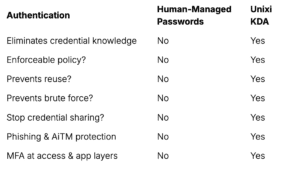
- End users have no password knowledge, control, or management.
- Password fields disappear from every application login.
- KDA authentication is calculated on the fly, never stored.
- Users cannot be phished.
- AiTM attacks are halted.
- MFA can be enforced at both the Unixi layer and the application layer.
The Password vs. Unixi Comparison
The Bottom Line
Hackers won’t stop targeting your organization. But you can stop leaving the door wide open with passwords.
It’s time to stop relying on the weakest link in your security chain, your end users. With Unixi Universal SSO, you eliminate password risks entirely and protect your business from the #1 cause of breaches: credential theft.
Don’t wait for the next breach headline. Eliminate passwords. Protect your future.