

The Identity Crisis: Vulnerabilities of Password Managers
Password managers are built on a simple idea: centralize all credentials into a single encrypted “vault”. By protecting this vault with one master password, organizations attempt to enforce strong, unique credentials across systems. However, this centralization creates a high-value target for adversaries. A breach of the vault provider or a privileged employee’s endpoint can lead to a cascading failure of the entire identity ecosystem.
In 2025, an estimated 19 billion passwords were stolen, with only 6% of these being unique and 42% failing to meet basic security length requirements. This data highlights the persistent failure of human-centric password management. Furthermore, the 2025 Verizon Data Breach Investigations Report indicates that 22% of breaches utilized stolen credentials as the initial access vector, and nearly 90% of attacks on basic web applications involved credential-based exploitation. The inherent risk of vault-based systems is that they treat credentials as static, reusable secrets that must be stored.
Table 1. Comparative Structural Security Models
| Security Attribute | Password Manager (Vault-Based) | Universal SSO (Unixi KDA) |
|---|---|---|
| Secret Storage | Centralized, static encrypted database | Decentralized, ephemeral on-the-fly derivation |
| Primary Failure Vector | Vault compromise or master password theft | No stored credentials to steal |
| Phishing Resilience | Low: Master passwords and tokens are harvestable | High: Credentials are domain-aware and non-reusable |
| Credential Life-cycle | Long-lived static secrets | Session-specific derived passphrases |
| Systemic Risk | High: Single point of failure for all accounts | Low: Decentralized, system-specific authentication |
| User Awareness | User knows and manages credentials | User is prevented from knowing or managing credentials |
| Adoption/enforcement | 15-30% adoption of the apps; optional usage of PW (users can reuse their weak passwords) | 100% enforcement; uSSO enforced authentication |
Case Study: The 2022 LastPass Data Breach and the Failure of Password Manager
The 2022 security incident involving LastPass provides an example of how a centralized vault architecture – as a single point of failure, can be systematically dismantled by a sophisticated adversary. The breach was not a singular event but a multi-stage campaign that exploited that single point of failure.
Phase 1: Developer Laptop Compromise and Source Code Exfiltration
The intrusion began between August 8 and August 11, 2022, when an attacker compromised the corporate laptop of a software developer. During this initial four-day window, the threat actor exfiltrated 14 of approximately 200 source code repositories, technical documentation, and an encrypted version of the server-side encryption (SSE-C) keys used to secure production backups in Amazon S3 buckets. While the company initially believed the incident was contained, the stolen source code provided the attacker with a technical roadmap of the internal infrastructure, enabling them to identify the specific senior engineers who held the master decryption keys.
Phase 2: The Plex Vulnerability and Keylogger Deployment
The second phase of the attack targeted one of only four senior DevOps engineers with access to the critical decryption keys. The attacker identified that the engineer was running a Plex media server on their home computer that had not been patched for a critical remote code execution (RCE) vulnerability. By exploiting this third-party application, the attacker gained full access to the machine and installed a keylogger. This malware captured the engineer’s master password in cleartext as they logged into their LastPass account.
Impact of the LastPass Data Breach
By September 2023, security researchers reported that stolen LastPass vaults were being successfully cracked through offline attacks. Investigations linked these breaches to over 150 victims, with losses exceeding $35 million, often tied to users who had stored cryptocurrency seed phrases in their vaults. LastPass did not publicly address the findings, citing ongoing investigations and legal matters. By 2025, a separate incident involving approximately $150 million in stolen assets was also attributed to the same 2022 breach.
Cryptographic Analysis: The ETH Zurich “Zero Knowledge” Disruption
In February 2026, researchers from the Applied Cryptography Group at ETH Zurich published a comprehensive analysis titled “Zero Knowledge (About) Encryption,” (to be presented at USENIX ’26) which challenged the foundational security claims of leading cloud-based password managers. The study analyzed Bitwarden, LastPass, Dashlane, and 1Password, uncovering 27 distinct attacks that a malicious or compromised server could execute against users.
The Universal SSO Paradigm: Architecting for a Post-Password World
Universal Single Sign-On (uSSO) represents a fundamental shift in identity architecture, moving from the management of static secrets to the on-demand cryptographic derivation of credentials. As implemented by Unixi, uSSO utilizes a browser extension to process authentication locally, eliminating the need for application-specific integrations or the storage of secrets on central servers.
Unixi’s Cryptographic Derivation and Hashing
Unixi’s KDA protocol utilizes a sophisticated concatenation and hashing process involving four distinct keys to generate a final, impenetrable credential:
- User Key: Binds authentication to the user’s base identity (passkey, or optional IdP) without exposing application credentials.
- Company Key: Establishes an organizational boundary, preventing cross-tenant credential replay and enabling centralized rotation.
- System Key: A unique key for every specific SaaS application. This ensures that the generated passphrase for one app cannot be reused for another, effectively closing the lateral-movement path a single compromised credential would otherwise open.
- Employee Key: Adds per-employee personalization, preventing credential sharing.
The derivation process applies a one-way cryptographic hash (e.g., SHA-512) to the concatenated inputs:
derived_secret = H(user_key ∥ company_key ∥ system_key ∥ employee_key)
As a result, the derived passphrase typically exceeds 80 characters, up to a maximum of 255.
A primary advantage of uSSO is that all authentication is processed locally within the browser extension. Because no passwords or secrets are stored on Unixi’s servers, there is no centralized database to breach. This architectural choice effectively removes the “Single Point of Failure” that proved fatal for LastPass. Furthermore, because the user never knows or manages the derived credential, they cannot be phished for it.
How uSSO Mitigates Legacy Attack Vectors
The technical superiority of uSSO becomes evident when mapping its defenses against the attack vectors that compromised legacy password managers.
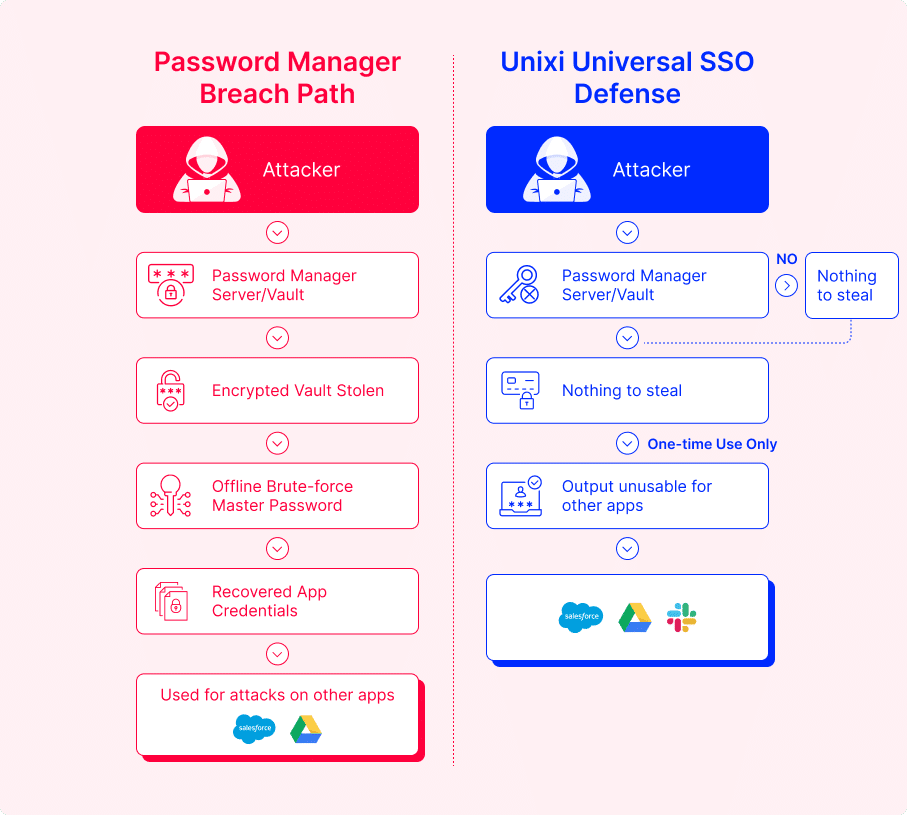
Preventing the LastPass “Cascade”
If the DevOps engineer at LastPass had been using Unixi’s Universal SSO, the breach trajectory would have been fundamentally disrupted:
- Keylogger Mitigation: Authentication is handled transparently by the browser extension, without manual credential entry. Since no passwords are typed or exposed to the user, keylogging malware has no usable input to capture, eliminating this attack vector entirely.
- Lateral Movement Halt: Because the KDA-derived credentials are system-specific, a compromise of the engineer’s personal credentials would not have granted access to the business-critical AWS environment. Each system requires a unique derivation that the attacker could not replicate without the full set of organizational keys.
- Defending Against Adversary-in-the-Middle (AiTM) and Token Replay is covered in detail in our previous blog series on AiTM and token replay.
- Users cannot authenticate without the Unixi extension, which prevents access from unmanaged devices entirely.
Password Manager based well-known CVEs
These four disclosed CVEs, spanning different vendors and vulnerability types, show how vault-based password managers create attack surfaces that a credential-less architecture avoids entirely, from insecure export functions and improper offboarding to local credential storage and input-sanitization flaws in the vault application itself.
CVE-2026-3107
A stored cross-site scripting flaw in Teampass password manager affecting the import functionality. Attackers can execute malicious JavaScript in user browsers.
CVE-2023-24055
KeePass through 2.53 (in a default installation) allows an attacker, who has write access to the XML configuration file, to obtain the cleartext passwords by adding an export trigger.
CVE-2024-39925
Vaultwarden 1.30.3 fails to rotate the shared organization key when members are offboarded, allowing former users to retain access to sensitive data. Combined with insufficient protection of encrypted server-side data, this enables authenticated users, especially former members with the key to potentially access and decrypt data from other organizations if they know the organizationId.
CVE-2023-27706
Bitwarden Windows desktop application versions prior to v2023.4.0 store biometric keys in Windows Credential Manager, accessible to other local unprivileged processes.
Conclusion
As enterprises move from traditional, centralized systems to complex SaaS environments, identity security must also evolve. Analysis of the LastPass breach and research from ETH Zurich clearly show the core weaknesses of centralized vault architectures. These systems create a single point of failure, rely on stored and reusable secrets, and are vulnerable to both server-side attacks and compromised user devices.
Universal Single Sign-On (uSSO), powered by Key-Derived Authentication, offers a more secure approach aligned with Zero Trust and Identity-First principles. By shifting authentication to the browser and removing stored credentials, uSSO:
- Removes the Central Target: There is no vault to breach, eliminating large-scale credential theft.
- Closes the Governance Gap: Provides visibility and control over all SaaS applications, including shadow IT.
- Improves Attack Resistance: Prevents phishing and AiTM attacks by using credentials that are unique, domain-bound, and non-reusable.
With password managers, security depends on user behavior if they choose to use or not the manager, or even continue using weak or reused passwords. This leads to low real-world adoption, often cited in the 15-30% range. On the other hand, Unixi enforces authentication through uSSO, ensuring consistent protection over 100% of the apps.
This represents a shift from managing passwords to eliminating them as an attack surface entirely.
Ready to bridge the gap between 20% adoption and 100% protection? Start your Free Trial to gain instant visibility into your SaaS environment and eliminate the central vault risk.